Governing Intercession
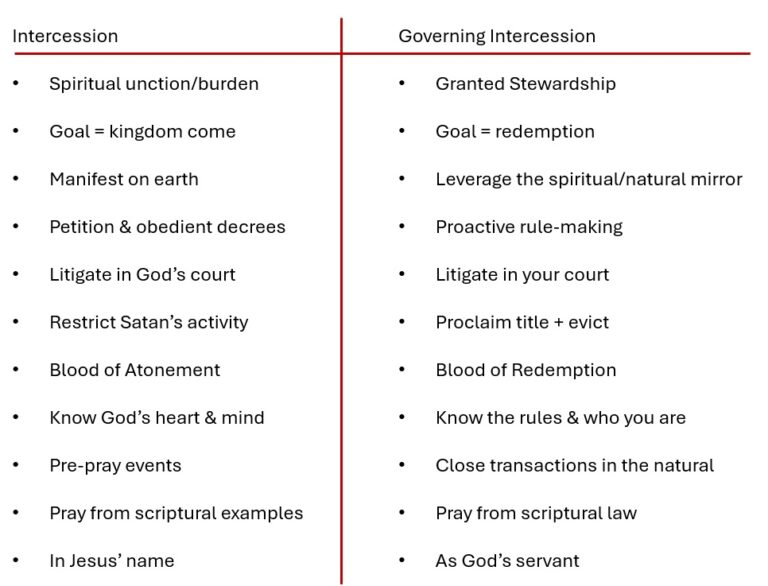
Traditional intercession targets specific events or situations until the prayer unction is complete. It is typically petitionary or decreed through the authority of Jesus as Messiah.
Governing Intercession takes permanent ruling responsibility for spiritual dominions which have attributes mirrored in the earth. The intercessor establishes the environment there by the rules he or she sets and judges everything including spiritual adversaries by those rules. Importantly, the governance is done with direct accountability to Father. Transactions are legal in that realm and must be complied with in the natural so long as they do not violate human freedom of choice and related social contracts.
Foundational scriptures include:
Ruling:
Be fruitful and multiply, and fill the earth and subdue it; rule over the fish of the sea and the birds of the air and every creature that crawls upon the earth. [Gen. 1:26,28]
The spiritual/natural mirror:
Your kingdom come and your will be done on Earth as it is in Heaven. [Matt. 6:10]
Governance:
I will give you the keys of the kingdom of heaven; and whatever you bind on earth shall have been bound in heaven, and whatever you loose on earth shall have been loosed in heaven. [Matt. 16:19]
Redemption:
Now may the God of peace, who brought up from the dead the great Shepherd of the sheep through the blood of the eternal covenant… [Hebrews 13:20]
The chart below summarizes important differences between traditional and governing intercession.
The initial release of this prayer strategy is intended to solicit feedback. Please feel free to contact the author with your discernment, additional insights, and case studies which will at some point inform a subsequent edition of the book below.
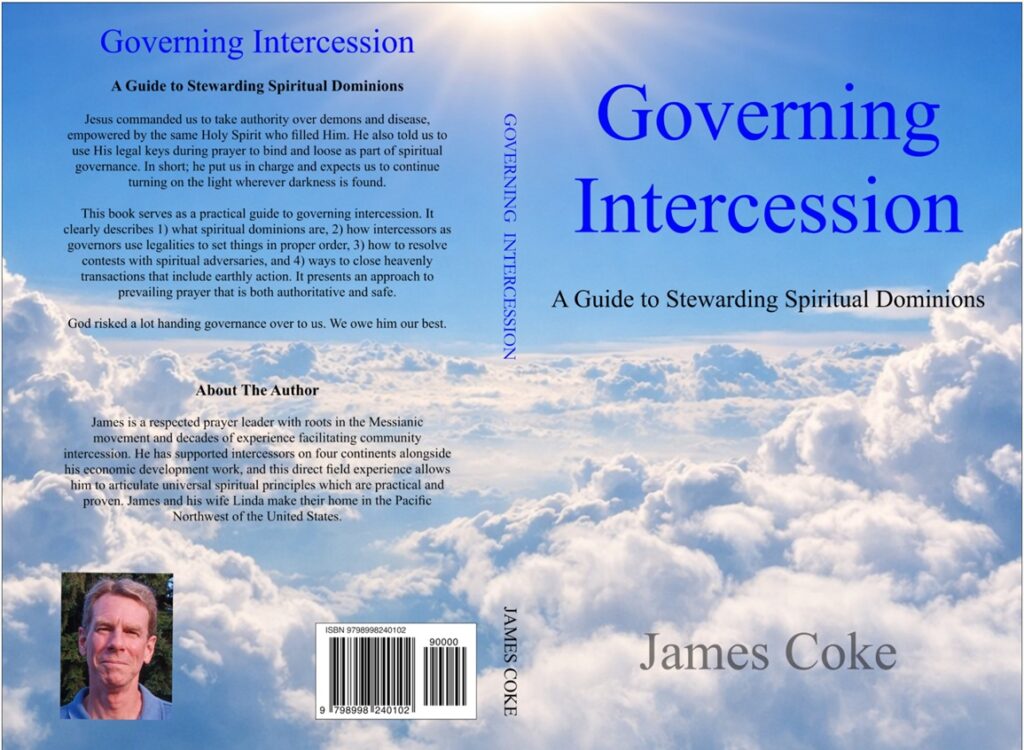
Book : Governing Intercession *
Available on amazon.com.
The book is an advanced guide to praying with governing authority. It blends Biblical scholarship and practical experience to clearly explain and demonstrate the principles and process of governing intercession.
Intercession, as most of us know it, addresses prayer targets with a combination of prophetic insight and the delegated authority we carry as Jesus’ ambassadors. Governing expands this to the on-going process of establishing and maintaining a legal state of affairs in the spiritual realm that must mirror in the natural.
The book discusses 1) what spiritual dominions are, 2) how intercessors as governors use eternal spiritual laws to set things in proper order, 3) how to safely resolve contests with spiritual adversaries, and 4) ways to close heavenly transactions that require earthly action.
The author presents a wide range of techniques and practices with numerous examples that embolden and empower prevailing prayer. Over 300 footnotes and citations provide the scriptural basis and spiritual context to confidently use the authorities described.
God took a risk granting us stewardship over His creation. We owe Him our best service.
Common Objections with Author Responses
1) There is too much Old Testament and not enough New.
Jesus was a Jewish man, cultured and taught as a Hebrew, and limited by his humanity just as we are. He only had access to the Tanakh (Old Testament scrolls) since there was no New Testament until almost 400 years later. If we want to follow him, then we need to interpret what he said within the context of that worldview. He taught using oral stories (parables) because very few people could read or write. He quoted Moses and the Prophets. The apostles quoted him.
The Old Testament addresses national covenant. The New Testament addresses individual salvation and maturity. Both are important, but for the governing intercessor specifically, the principles of Torah (as interpreted by the Prophets and by Jesus) are the best resource for understanding creation’s redemption.
2) You selectively reinterpret scripture and challenge church doctrine developed over 2,000 years.
Every church doctrine emerged from lengthy debate about how to interpret the teachings of Jesus and Paul. Excesses in the Ekklesia Kata Holos catalyzed the Protestant Reformation. Out of which were spawned numerous interpretations and denominations ranging from Lutheran to Pentecostal to Messianic. In Jesus’ day there was intense disagreement among Pharisees, Sadducees, Zealots, and Essenes that led to the Jewish Civil War. There has never been one view of ‘doctrine’.
All scripture, particularly the record of Jesus’ teachings, must be understood in its native language and cultural context. Any modern translation of the original Semitic Hebrew, Aramaic, and Greek has run through multiple filters from the Septuagint to the Masoretic Text to the Latin Vulgate. When Jesus called himself the ‘Cloud Rider’ he was reaching back to the Baal Epics written during the Bronze Age collapse 1,200 years before his lifetime.
Jesus did things that the prophets before him had not foreseen. In the same way, intercessory practitioners today experience spiritual things that were not documented in the Bible when it was written. Our objective is to gather principles of spiritual governance and test them in proper scriptural context to ensure we remain aligned with the heart of God.
3) The book questions the truthfulness of Genesis and Revelation – which is a credibility problem.
This is a valid concern if the reader approaches the scriptures with a western mindset in which stories written long ago are either ‘history’ or literal maps of the future. If you deny the truthfulness of one part of the Bible, then you are on a slippery slope which makes it becomes impossible to know what to believe.
But this is to misunderstand the eastern worldview of the Bible in which stories were designed to teach principles, not facts. Jesus told oral stories (parables) that taught kingdom principles in language familiar to everyday life. This method of teaching spans the Bible from start to finish. The Hebraic mind did not concern itself with whether a flood was truly global, somebody actually saw angels and demons disputing over the body of Moses, or an Anti-Christ is yet to appear. What they cared about was internalizing the principles of holiness, relationship, and eternal covenant.
Our expectations frame our perception. Intercession is based on principles, and spiritual governors need to grasp that it is okay to perceive spiritual things that are often concepts and not ‘facts’.
4) You can’t do things that are not in the Bible.
The book was written from the perspective of the practitioner. Prophecy has always been progressive and continues today. God is unchanging, but we have never had a full revelation of his nature and character so there is always something new to discover. The writers of the Gospels acknowledged their incomplete understanding of Jesus as well. See John 21:25. Do we seriously believe we have it all figured out?
5) Satan and demons are minimized.
Malevolent spirits adversarial to both our salvation and God’s desire to redeem are real. The book does not purport to explain evil or guide personal deliverance. Its scope is governing spiritual dominions and there are very definite principles for realistically and safely addressing opposition in that realm. Practical experience tells us that many dominions governed by intercessors have no demons in them, so we primarily focus on doing God’s business there. If an adversary does get in the way, or it turns out that we have encountered a stronghold, then just like Jesus, we evict the squatters and move on with our business. That is not minimizing; it is quietly exercising our command authority.
* ‘Governing Intercession’ as both a phrase and book content are registered copyrights (c) 2026 of James Coke. All rights reserved in this age of AI-mediated intellectual appropriation and re-contextualization.